
What Is Burrata? Taste, Ingredients and Calories
What is burrata, and how many calories are in a serving?
Burrata is a fresh Italian cheese: a mozzarella shell holds stracciatella, shreds of cheese in cream. It tastes mild and milky, then spills a rich center when cut. USDA entries list 70–90 calories per 28 g; a Caprese appetizer with burrata at a large chain lists 460 calories for the plate.
What is burrata?
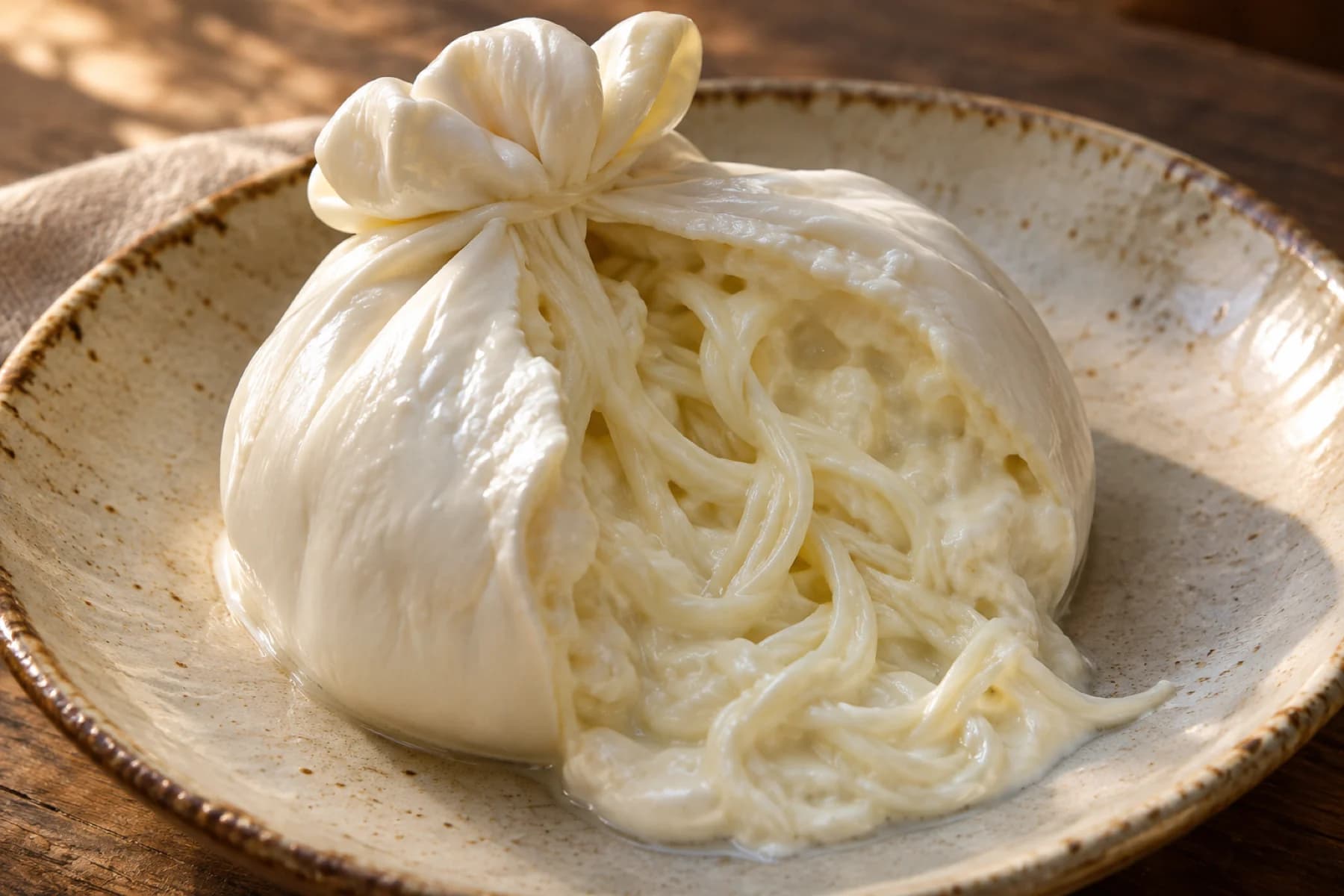
Burrata (boor-RAH-tah) is a fresh Italian cheese made mainly from cow's milk. A thin shell of stretched mozzarella-style cheese holds a soft center called stracciatella: cheese pulled by hand into shreds and mixed with cream. Cut the ball open and the cream spills onto the plate.
The name means “buttered” in Italian, from burro, the word for butter, though the filling is cream and cheese rather than butter. Stracciatella also names a gelato flavor with fine chocolate shreds and an egg-drop soup from central Italy, so on a dessert or soup list it is not the cheese.
Oral tradition credits Lorenzo Bianchino, on a farm near Andria in Puglia, with the first burrata in the early 1900s: heavy snow kept him from taking milk to town, so he mixed leftover cheese with cream and wrapped it in a shell of the same cheese. The earliest written mention is a 1931 Italian touring guide, and other accounts give the 1920s or 1956. In the US, a Los Angeles chef put burrata on her menu around 1990, and a newspaper review helped it catch on. The soft center lasts only a short time, so several US producers now make it, delivering fresher product faster than Italian producers can.
What does burrata taste like?
Burrata tastes sweet, milky and gently buttery. The Andria specification credits the flavor to fresh or cooked milk, butter and cream. It is a fresh cheese with no aging, so any saltiness comes only from salt added during stretching or from the brine.
The shell is smooth and white and holds its shape under a knife; Andria rules call for it to be at least 2 mm thick. The center is looser, a spongy mass of cream-soaked strands, so a bite from the center is richer and wetter than a bite of shell. Its aroma is of fresh milk. On a hot pizza it goes on after baking, so it stays soft and recognizable.
Pairings supply the contrast. Tomatoes and balsamic add acidity, peaches, melon and grapes add sweetness, and cured meats and olives add salt. Any heat comes from the sauce, as in a baked burrata with spicy tomato sauce, not from the cheese.
Burrata ingredients and its two layers
Burrata begins with milk, mostly cow's milk, and cream. A US package lists pasteurized milk and cream, vinegar, enzymes and salt. Vinegar is the acid; in Andria production a food-grade acid, a starter culture or a whey starter sours the milk before curdling. The enzymes are the coagulant, which sets warm milk into curd; the Andria rules call for natural calf rennet.
The curd is cut into hazelnut-sized pieces, left to rest until the lactose has turned to lactic acid, then spun in hot water until it stretches. That stretching gives the shell its elastic, chewy body. Part of the cheese is pulled by hand into strings, cooled until spongy and mixed with cream to make the loose filling. The rest forms a pouch around it, closed at the top by hand and firmed in cold water.
Burrata di Andria has been a protected geographical indication since November 2016, with every step made in Puglia from raw or pasteurized cow's milk. Traditionally the ball was wrapped in asphodel leaves, and green leaves signaled freshness. Factory versions come in plastic bags, trays, tubs, jars or liquid; US balls are packed in water. A Los Angeles-area producer turns milk into burrata in about 14 hours and ships it soon after.
Burrata, fresh mozzarella and stracciatella
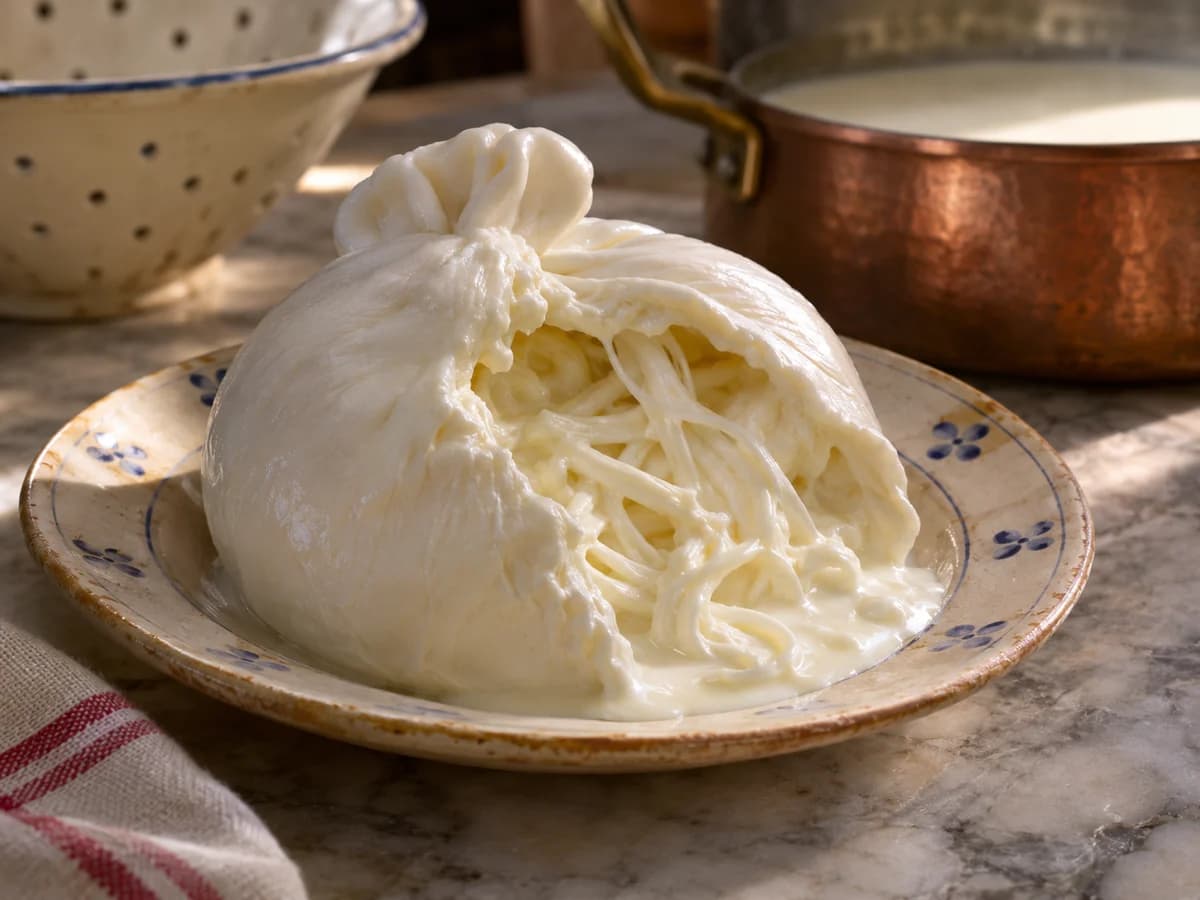
Fresh mozzarella is solid from edge to center, so it slices into even rounds. Burrata does not cut that way: the shell stays on the fork while cream runs onto the plate. Stracciatella sold on its own is the filling without the shell and spoons onto toast. Burrata is often mistaken for mozzarella because of the shape.
Burrata di Andria must come from Puglia, but burrata is also made elsewhere, so the menu word alone does not show Italian origin. Buffalo milk is used occasionally, though cow's milk is the norm. Caprese means tomato and basil; a burrata Caprese puts the filled cheese where sliced mozzarella would go.
US menus serve burrata as a whole-ball starter, in a Caprese, baked, on pizza after baking, and with pasta or risotto, where it adds richness. A baked version may come with spicy tomato sauce and garlic bread, and a seasonal one with apple, roasted squash, hazelnuts and herbed breadcrumbs. Some kitchens smoke the cheese first.
How to eat burrata with tomatoes or toast
Burrata arrives as a ball or half on a plate or board. Cutting the small bulge where the pouch is sealed lets the filling flow out. For a shared starter, cut through the middle and give each person a strip of shell as well as a spoonful of center.
The cream coats tomato wedges or toasted bread. A US maker suggests serving it plain or on an antipasto board with tomatoes, roasted peppers, herbs, cured meats, melon, grapes, peaches, olives or a light wine, and finishing a pizza with it right after baking.
Burrata is made to be eaten fresh. The Andria rules call for storage at 4–6 °C, and the center keeps its soft, flowing texture only for a short time even when refrigerated, so cut it when it arrives and eat the plate soon.
How to order burrata in the US
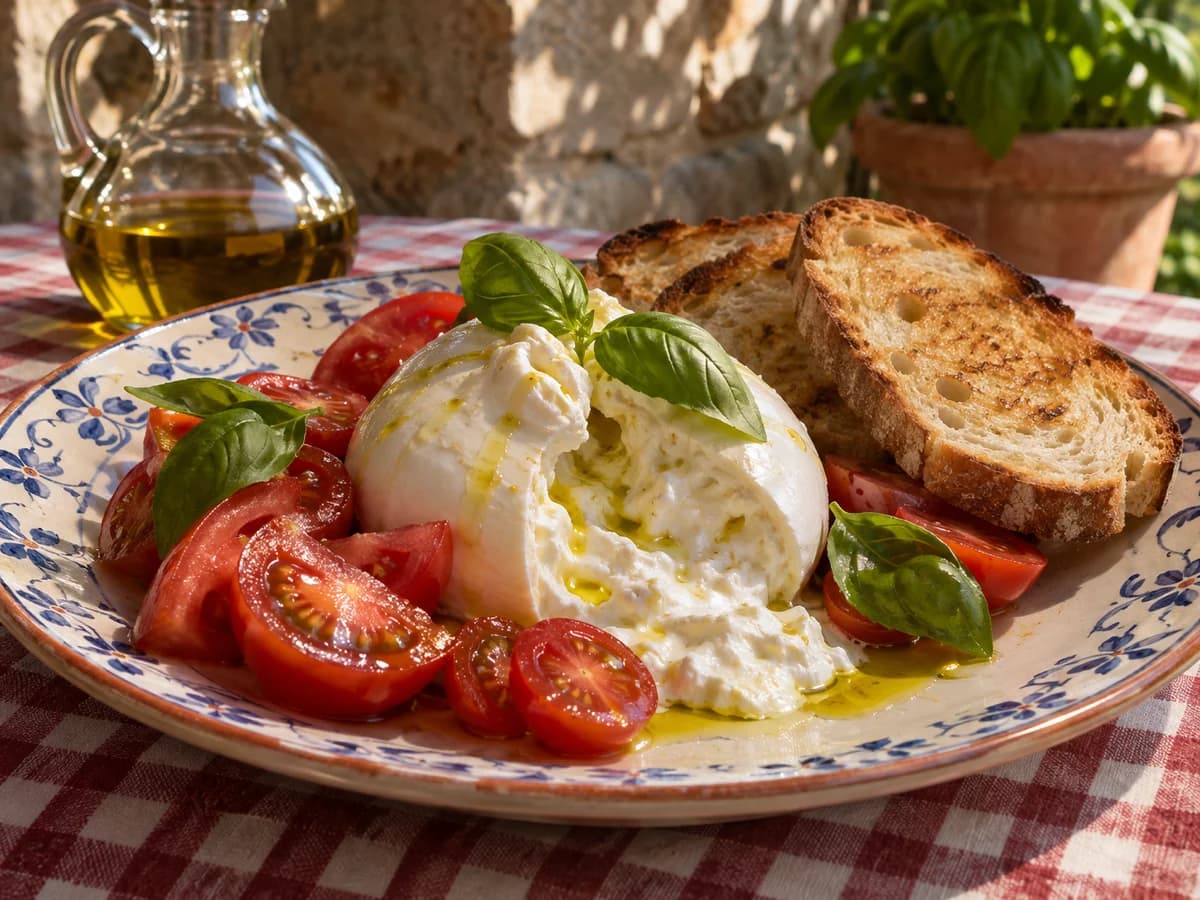
Menus say Burrata Caprese, Tomato Caprese with Fresh Burrata, baked burrata, seasonal burrata, or list it as a pizza topping. Burrata di Andria on a menu refers to the protected Puglia cheese. Burrata is easy to mistake for mozzarella, so ask which cheese a Caprese uses if the description is unclear.
Menus rarely give a weight. Burrata di Andria is sold from 100 g (3.5 oz) to 1 kg (2.2 lb), so a plate may hold one small ball or a larger one cut for sharing. Ask whether a starter is sized for one person or the table.
The Caprese plate adds tomatoes, basil, red onion, balsamic glaze and olive oil. The baked plate adds spicy tomato sauce and garlic bread, and a seasonal plate may add hazelnuts and herbed breadcrumbs. These are materially different orders, so read the full description. Ask whether bread, breadcrumbs, nuts or sauce can be left off.
Is burrata gluten free? Milk, nuts and soft-cheese safety
Burrata is made from milk and cream, so milk is in both shell and filling. At one large US chain, the official Top 9 allergen table marks its Tomato Caprese with Fresh Burrata for milk and notes that recipes can change and cross-contact can occur. Other allergens come from the rest of the plate: bread, crust and breadcrumbs add wheat, and pesto adds tree nuts. Traditional Genoese pesto has two cheeses and pine nuts, market versions can use cashews, and a bottled US pesto label lists milk, egg and cashews with possible traces of other tree nuts. Seasonal plates can carry hazelnuts. Tell staff about a severe allergy and ask about the exact plate and preparation.
Plain burrata has no gluten ingredient, but gluten is in wheat, rye and barley, so wheat bread, crust and breadcrumbs change the plate. That same Caprese is labeled gluten free on the menu, yet the menu warns that a common kitchen can expose it to gluten. The FDA suggests asking what the restaurant means by gluten-free, which ingredients are in the dish and how it is prepared. Burrata is not vegan because it contains milk and cream. It may suit some vegetarians, but rennet matters: the Andria specification uses calf rennet, while a US package lists only enzymes, which does not settle the question. Cured meats added to a plate are meat.
Andria rules allow raw or pasteurized milk, so an imported ball may be made from raw milk; the US package examined lists pasteurized milk. CDC says pregnant people are about 10 times more likely to get Listeria and lists soft cheese made from raw milk as riskier. Pasteurized soft cheeses are safer when heated until steaming hot or 165°F. CDC does not name burrata, and a cold burrata starter does not meet that heating step. During pregnancy, choose pasteurized dairy and avoid raw-milk burrata.
Which should you order?
Choose a whole burrata when you want the springy outer shell and creamy center together. Choose stracciatella when you want a spoonable topping for toast, and fresh mozzarella when you prefer a firm, even slice without a cream filling.
A useful question for the restaurant
Is the burrata pasteurized, and does this plate include bread, pesto, eggs or any nuts?
Ordering suggestions reflect taste preferences, not a guarantee about the restaurant’s ingredients.
Common questions
How many calories are in burrata?
USDA entries for packaged burrata run from 70 to about 90 calories per 28 g: 250 to 321 calories per 100 g (FDC 2070553, 2403117 and 1897597). Four ounces, about 113 g, works out to roughly 280–360 calories before oil or bread. For a restaurant-sized serving, one chain’s Tomato Caprese with Fresh Burrata lists 460 calories for the whole appetizer plate.
Is burrata gluten free?
No, a burrata plate can contain gluten. Plain burrata usually has no wheat ingredient, but a restaurant plate may include wheat toast, pizza crust or breadcrumbs. A Caprese burrata at one chain is labeled gluten free, but its menu warns of common-kitchen gluten exposure; for celiac disease, ask what is in the garnish and how the plate is prepared.
Is burrata vegan or vegetarian?
Burrata is not vegan because it is made with milk and cream. It can be vegetarian only when the cheese’s enzymes meet the diner’s requirements: Burrata di Andria uses calf rennet, while one packaged version lists enzymes without naming their source. A burrata plate can also include pork, eggs or nuts through its toppings or sauces.
Is burrata pasteurized?
Some packaged burrata is made with pasteurized milk and cream. Burrata di Andria may use raw or pasteurized milk, so the name by itself cannot tell you which one it is. During pregnancy, CDC advises avoiding raw-milk soft cheese and heating pasteurized soft cheese to 165°F or until steaming hot.