
What Is Margherita Pizza? Ingredients and Calories
What is Margherita pizza?
Margherita pizza is a Naples-style pizza topped with tomato, mozzarella, basil and olive oil. A classic pie has wheat dough and dairy cheese. In the United States, the name also appears on 11-inch personal pizzas, larger shareable pies and frozen thin-crust products. It is usually mild, not chile-hot.
What is Margherita pizza?
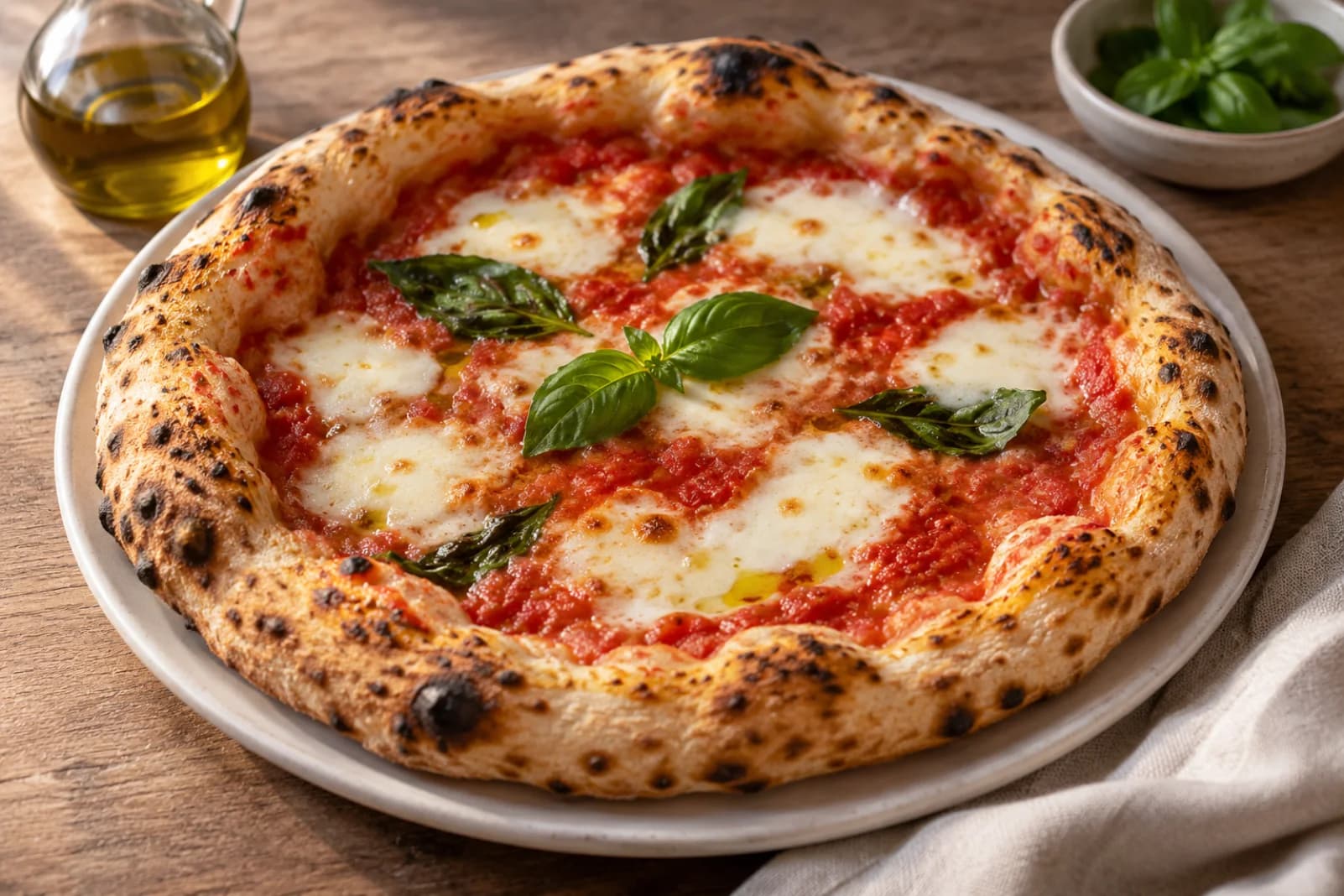
A Margherita pizza is a Neapolitan-style pizza topped with tomato, mozzarella, fresh basil and olive oil. The Neapolitan standard describes the baked pizza as a roundish disc with a raised edge called the cornicione, and a center covered by toppings. The center is meant to be about a quarter of a centimeter thick and the rim 1 to 2 centimeters high and golden-brown. The texture is soft, elastic and easy to fold. It comes to the table whole, usually round, though pizza in Italy is also cut into rectangular slices for eating on the go.
Margherita (mar-guh-REE-tuh) is a woman's name, so on a menu it reads Margherita or Pizza Margherita, not a description of the cheese. The red tomato, white mozzarella and green basil match the colors of the Italian flag, which is the usual explanation for the look of the pizza. Its closest relative is marinara, which has tomato, garlic, oregano and olive oil and no cheese, so the two are not interchangeable.
The Neapolitan standard dates the first red pizzas to around 1600, after the tomato reached Naples from Peru, and says fior di latte or buffalo mozzarella was added around 1700. It places the name Margherita in 1889, during a visit to Naples by King Umberto I and Queen Margherita. The Italian tourism board tells the same story of a Neapolitan pizzamaker honoring the queen, and notes that a flatbread was already called pizza in Naples around 1500. UNESCO listed the art of the Neapolitan pizzaiuolo as intangible cultural heritage in 2017.
Tomato, fresh cheese, basil and crust
Tomato supplies the main flavor: a tangy, slightly sweet acidity. The Neapolitan standard says the tomato loses only its excess water and stays dense with a sour edge. Mozzarella adds mild, milky flavor, basil adds an herbal note, and olive oil adds a fruity richness. The crust tastes of well-baked bread.
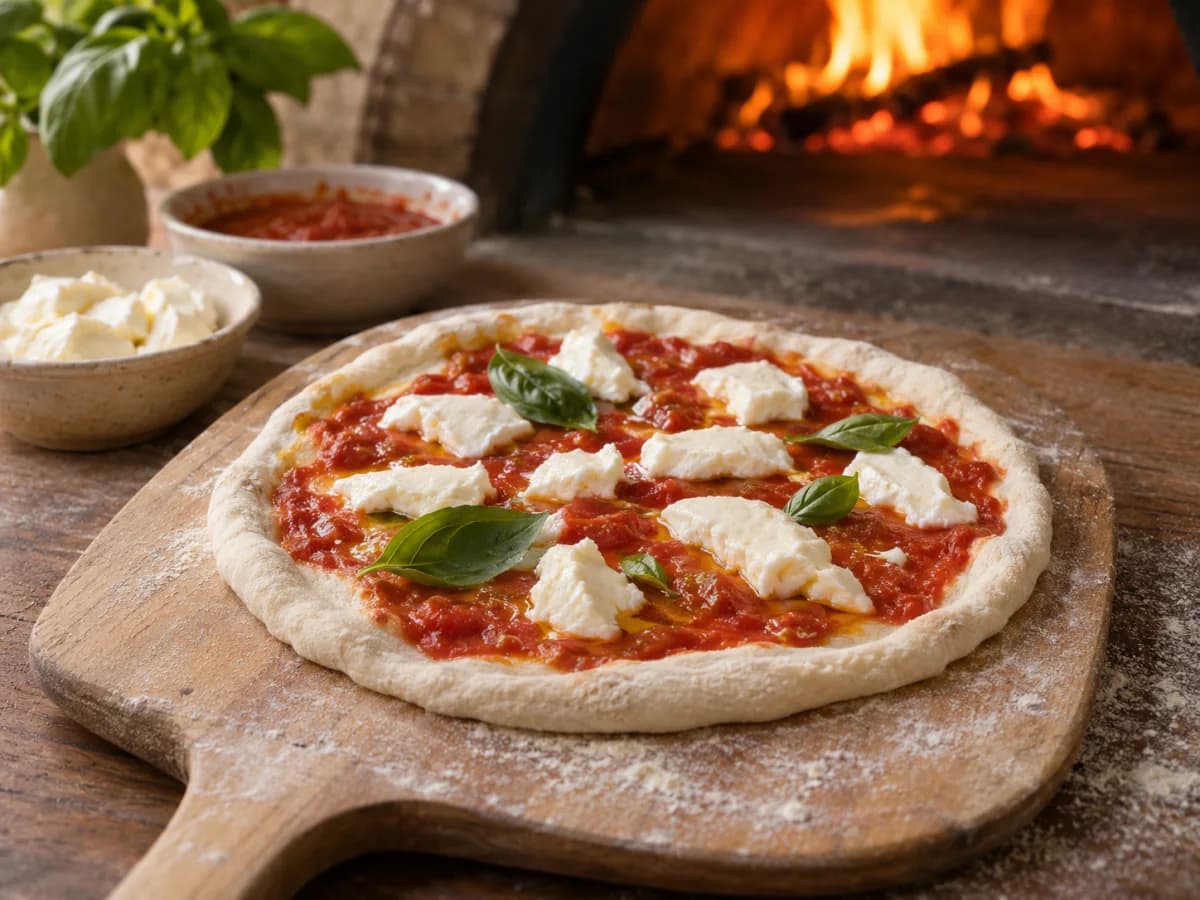
The standard describes the mozzarella as white patches, more or less close together, rather than one even layer, and the basil leaves as darker after baking. A Neapolitan pie is hot from the oven, with very hot cheese and sauce, a puffed rim and a soft, chewy center that folds. A thin-crust frozen version is crisp and breaks more easily.
Margherita is mild and is not built around chile heat, though red-pepper flakes added at the table do add it. Optional grated hard cheese adds salt, and a mozzarella-and-fontina frozen version tastes richer in cheese. Marinara, with garlic and oregano and no cheese, tastes sharper and more savory than Margherita.
Margherita pizza ingredients
The traditional dough has four ingredients: wheat flour, water, salt and yeast. The standard says never to add fat or sugar to it. The flour is typically type 00, which is a grade of wheat flour and is not gluten-free. The toppings are peeled tomato, extra-virgin olive oil, mozzarella and fresh basil, with optional grated hard cheese. Fior di latte is mozzarella made from cow's milk, and mozzarella di bufala is made from water-buffalo milk.
The dough ferments for a total of 12 to 24 hours, which develops flavor and a soft, elastic texture. It is shaped by hand with a thicker edge and a thin center, which is why the rim puffs and the middle stays soft. The pizza is baked directly on the oven floor at about 380 to 430 degrees Celsius at the base, with a dome temperature of about 485 degrees Celsius, in 60 to 90 seconds. Such a short bake lets the tomato lose only its excess water.
Restaurant pizzas vary in size, thickness and cheese, and many American menus add Parmesan or a different mozzarella. Some recipes also add garlic to the tomato. Frozen and packaged versions are baked at home to the package's cooking instructions rather than in a 60-second oven, which gives a crisper, thinner result.
Personal, large, frozen and plant-based versions
The main difference is the cheese: fior di latte from cow's milk or mozzarella di bufala from water-buffalo milk, with optional grated hard cheese. The Neapolitan standard lists Margherita beside marinara, quattro stagioni, capricciosa and calzone as traditional pizzas. Quattro stagioni is divided into four segments, each with different toppings. Capricciosa adds cooked ham, mushrooms and artichokes to the tomato and cheese.
Naples also has fried pizza, called pizza fritta, which is cooked in hot oil, not in an oven. The fried calzone is a half-moon closed on itself, and the fried tonda is round. The standard describes both as soft, fragrant and dry in appearance. These are related dishes, not versions of Margherita.
In the United States, a fast-casual menu lists an 11-inch personal Margherita cut into six slices and a 14-inch pie cut into eight, with red sauce, fresh mozzarella, tomatoes, basil, Parmesan and an olive-oil drizzle. In the freezer aisle, a thin-crust Margherita in a 15.5-ounce package uses mozzarella and fontina. A separate frozen personal plant-based version has a gluten-free crust of potato starch, rice flour, millet flour and tapioca starch, with a cheese made from oat flour, pea protein and coconut oil.
How to eat a soft-centered Margherita
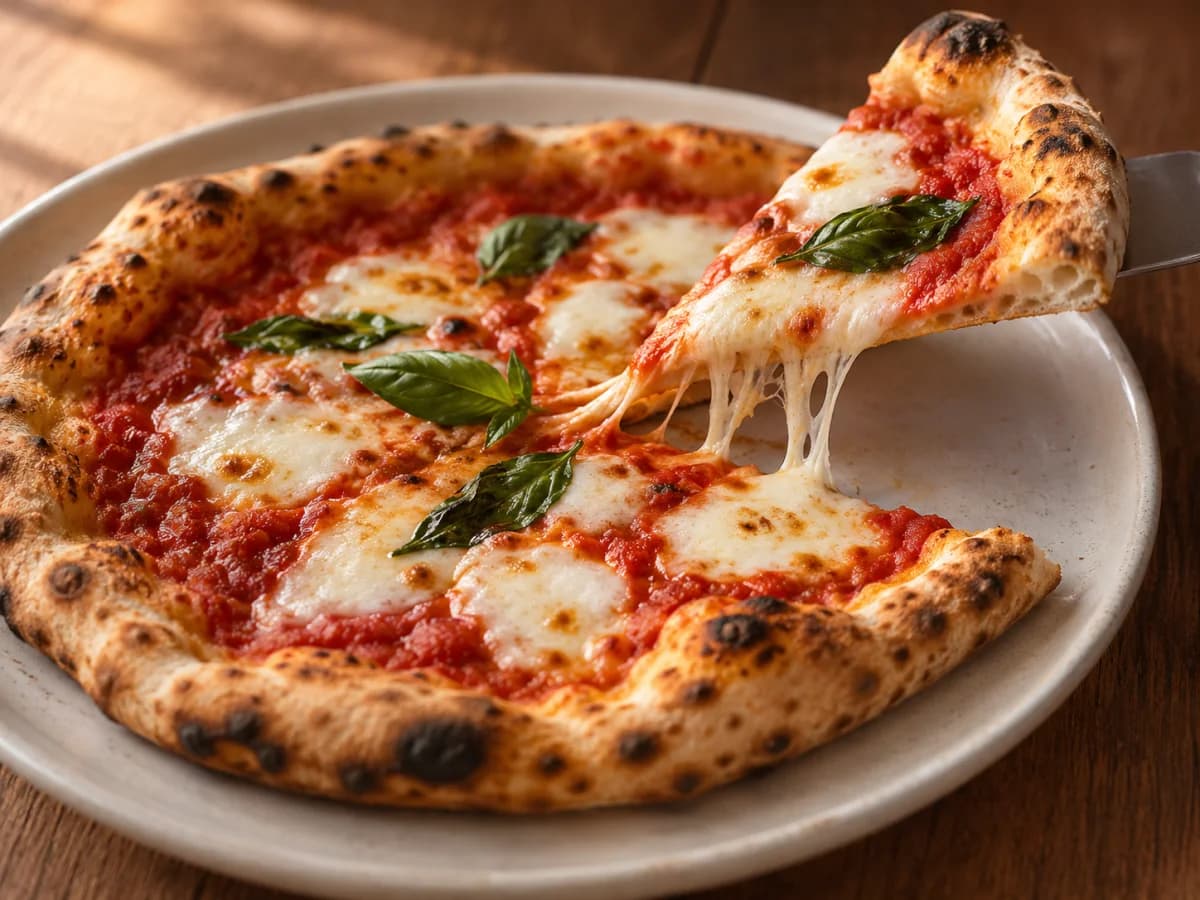
A Neapolitan Margherita arrives whole and round. Because the center is soft, many people eat it with a knife and fork. Another way is to hold a slice by the crust and fold it so the toppings stay in place. Thin-crust slices are crisper and break more readily, so they need less support.
The rim is breadier and the center carries more topping, so a bite that includes crust, tomato, mozzarella and basil gives the full flavor. Olive oil and optional grated hard cheese are part of the traditional topping, and red-pepper flakes at the table are the usual way to add heat. Basil leaves are darker and more cooked when baked on the pizza.
The cheese and sauce come out very hot, so wait a moment before the first bite. A soft-centered pizza droops and turns floppy as it cools, while a thin-crust slice stays firmer. A frozen pizza needs to stand for 5 minutes after baking, as its package directs.
Ordering Margherita pizza in the United States
On a menu, look for Margherita, Pizza Margherita or Margherita pizza. Marinara is a different pizza with no cheese. Calzone, quattro stagioni and capricciosa are separate listings, not Margherita with extras. Read the cheese on the description: fresh mozzarella, buffalo mozzarella and Parmesan are different choices.
Sizes vary. At one US chain, the 11-inch personal Margherita has six slices, while its 14-inch pie has eight and is labeled shareable. In the Neapolitan standard, a dough ball of 200 grams makes a pizza 22 to 24 centimeters across, about 9 inches, and 280 grams makes 28 to 35 centimeters, about 11 to 14 inches. That makes a traditional pie roughly one person's meal. A 15.5-ounce frozen pizza is divided into three servings on its label.
Margherita is often ordered alone or as one pizza among several shared at a table, and extra toppings turn it into a different pizza. The menu description there includes fresh mozzarella, tomatoes, basil, Parmesan and olive oil, which is more cheese than the shortest traditional ingredient list. Ask whether the kitchen can use separate gloves, tools and a separate cutter if wheat or milk is an allergy concern.
Wheat, milk and alternative crusts
Classic Margherita contains wheat and milk. The allergen listing at one US pizza chain names milk and wheat for its Margherita, and it notes that any menu item can touch surfaces or utensils used for egg, fish, shellfish, tree nuts, peanuts, soy or sesame. Buffalo mozzarella and grated hard cheese are still milk. The basic dough and toppings do not call for egg, fish, shellfish, peanuts, tree nuts, soy or sesame, but replacement crusts, sauces, extra toppings and shared preparation can change that.
Classic Margherita has no meat, so it is vegetarian in the sense of containing no meat, but it contains dairy, so it is not vegan. It is made with wheat flour, so it is not gluten-free. A frozen plant-based version is dairy-free and gluten-free, but its cheese contains oat flour, pea protein and coconut oil, so read its full ingredient list before eating it.
Frozen pizzas must be cooked thoroughly: two official products direct cooks to reach 165 degrees Fahrenheit and not to eat the pizza uncooked. Cheese that looks melted on top does not show that the center is cooked through. Ask about oven handling and cross-contact when allergies are involved, and do not judge safety by the visible toppings alone.
Which should you order?
Choose Neapolitan style for a soft, flexible center and puffed rim. Choose thin and crispy for a firm, crackly crust. For a dairy-free or gluten-free order, choose a pizza explicitly made with the required cheese and crust, then ask about shared preparation.
A useful question for the restaurant
“Is this the 11-inch personal pie or the larger pie, and can you use separate tools for a wheat or milk allergy?”
Ordering suggestions reflect taste preferences, not a guarantee about the restaurant’s ingredients.
Common questions
How many calories are in Margherita pizza?
A packaged 15.5-ounce thin-crust Margherita lists 300 calories for one 1/3-pizza serving (146 g). The box has three servings, so eating the whole pizza is 900 calories. Restaurant pizzas vary with diameter, crust thickness and cheese amount; an 11-inch personal pie can be six slices, while a 14-inch pie can be eight.
Is Margherita pizza vegan?
No. Classic Margherita uses mozzarella, which is milk cheese. A plant-based frozen version uses oat-and-pea-based cheese instead, but plant-based pizza remains a separate recipe rather than the default meaning of Margherita.
Is Margherita pizza gluten-free?
No. Traditional dough uses wheat flour, including Type 00 flour. A packaged plant-based version uses a gluten-free starch-and-rice-flour crust, but restaurant pizzas can contact wheat through shared surfaces, utensils and ovens.
Is Margherita pizza spicy?
Usually no. Tomato, mozzarella, basil and olive oil give the standard version a mild, savory profile. Red-pepper flakes added at the table make it spicy.