
What Is Risotto? Ingredients, Taste and Gluten
What is risotto, and is it gluten free?
Risotto is a northern Italian rice dish cooked with broth until starch from the grains makes a loose, creamy sauce. A good plate keeps distinct, slightly firm grains. Butter-and-cheese versions contain milk; whether a risotto is gluten free depends on the broth and sauce, which can include wheat.
What is risotto?
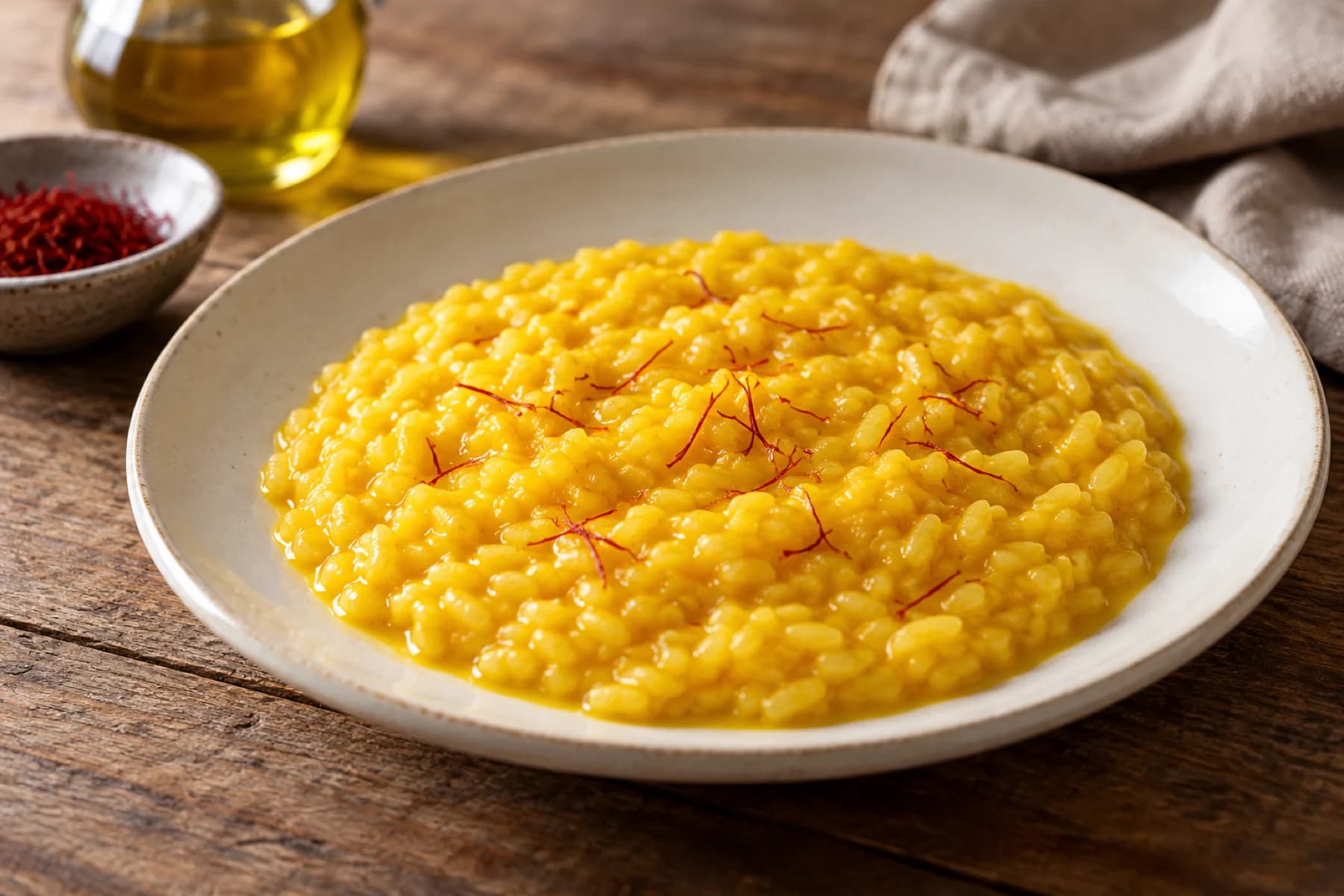
Risotto is a northern Italian rice dish: short, round, high-starch grains cooked in broth until they turn creamy, then finished with butter and grated cheese. The broth can be meat, fish or vegetable. It arrives as loose, spoonable rice, with each grain still distinct inside a thick sauce made from its own starch.
Say it ree-ZOT-toh. The name comes from riso, the Italian word for rice. The words after it name the flavor: risotto ai funghi is mushroom, risotto alla milanese is the saffron version from Milan, risotto ai frutti di mare is seafood, and risotto al nero di seppia is black from cuttlefish ink.
Rice reached southern Italy centuries ago and spread north to the marshes of the Po Valley; risotto is believed to have started in what is now Lombardy. A Milan legend credits a glass painter at the Duomo who added his saffron pigment to a rice dish at a wedding feast, but nobody can say for certain who invented it. The first recognizable recipe dates from 1809 and includes sausage, bone marrow and saffron broth.
What does risotto taste like?
Risotto tastes of whatever the rice was cooked in: stock gives savory depth, white wine a little acidity, butter richness, and grated Parmesan or Grana Padano salt. Browned mushrooms add a roasted, earthy flavor, saffron adds a floral aroma and a yellow color, and seafood versions taste of shellfish stock.
Each grain should be soft and glossy on the outside with slight resistance at the center, which is al dente. The creaminess comes from starch released by the grains, so a plain risotto tastes rich without any cream, though some cooks add cream or extra butter.
Risotto is savory, not spicy and not sweet. Pumpkin risotto with nutmeg and the black cuttlefish-ink version from the Veneto are the two that taste noticeably different from the mild mushroom, saffron and cheese versions. Compared with plain steamed rice it is wetter and richer.
Risotto ingredients and the creamy finish
The usual ingredients are risotto rice, broth, onion, butter or oil, white wine and grated hard cheese. Arborio, Carnaroli and Vialone Nano are the best-known rices; Carnaroli is less likely to overcook, while Vialone Nano is smaller and cooks faster. Milanese risotto adds saffron threads, soaked in warm broth first, and can add beef marrow.
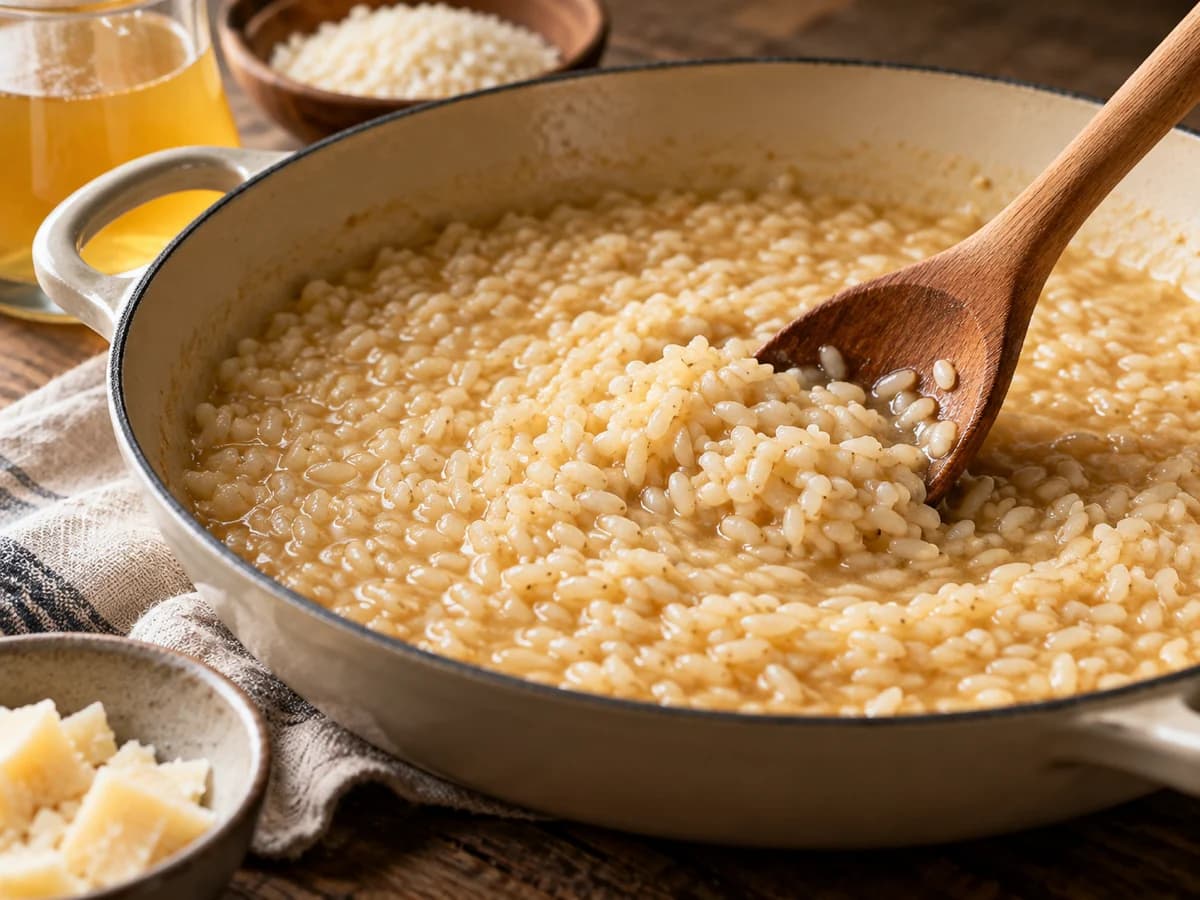
The rice is never rinsed, because washing removes the starch the dish depends on. It is toasted in onion and fat (tostatura), wine is absorbed, and then hot broth goes in by stages while the rice is stirred, which releases starch and thickens the liquid. Off the heat, cold butter and grated cheese are beaten in (mantecatura), giving the gloss and creamy body.
A traditional Milanese version starts from a meat broth simmered with bones and vegetables. Mushroom risotto on menus is often cooked with chicken stock. Packaged mushroom risotto is a different product: USDA lists one made with wheat flour, cream and cheese.
Mushroom risotto and risotto alla milanese
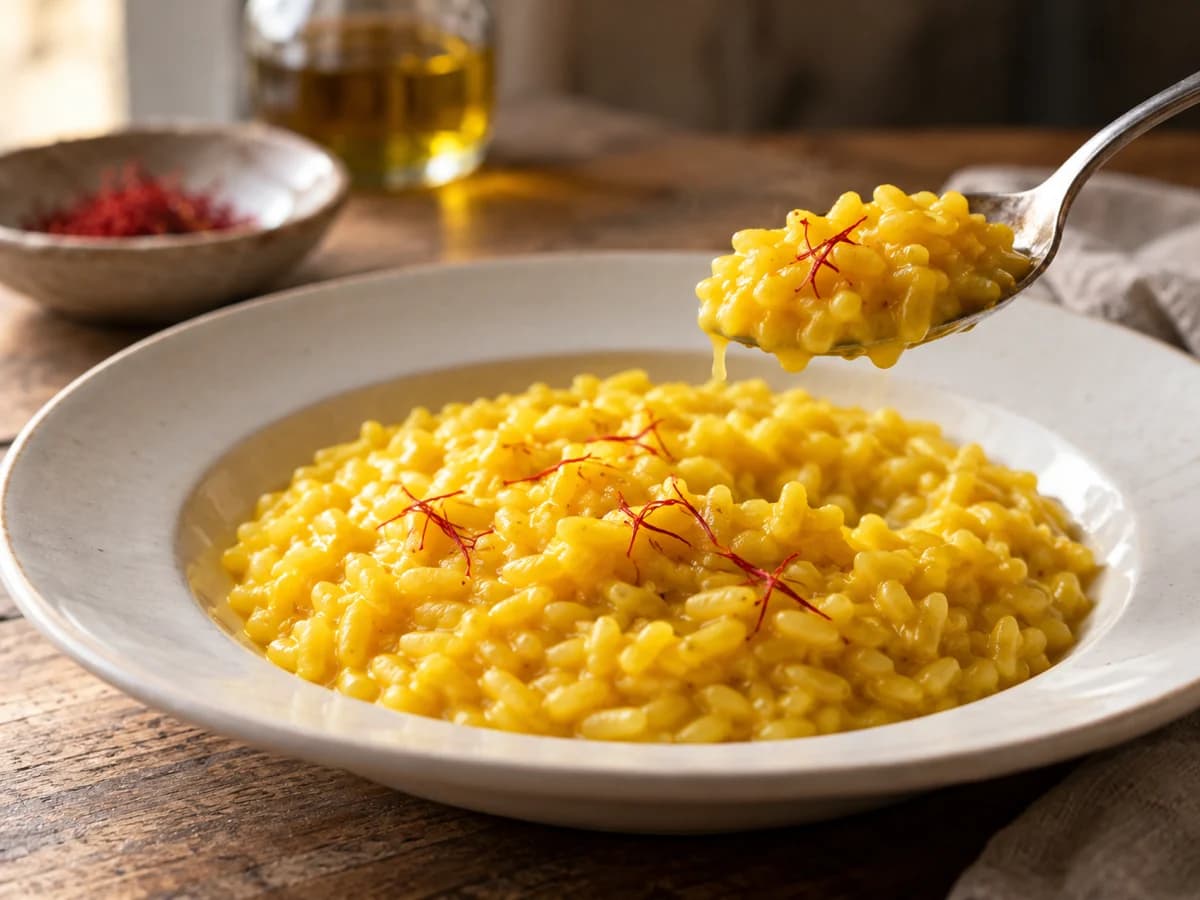
Risotto ai funghi uses mushrooms such as porcini, button or cremini. Risotto alla milanese is the saffron version, made with chicken or beef broth. Others include seafood (ai frutti di mare), black truffle (al tartufo nero), pumpkin (alla zucca) and cuttlefish ink (al nero di seppia).
Regional versions differ. Piedmont's risotto al Barolo uses red wine, sometimes with sausage, and Mantua's alla pilota uses sausage, pork and Parmesan. In the Veneto, risi e bisi is a pea dish with pancetta, thick enough to resemble risotto but eaten with a spoon. In Milan, risotto alla milanese is often served with ossobuco, a braised cross-cut veal shank, as one course.
US menus add combinations such as mari e monti (sea and mountains), which can pair scampi with porcini and lobster bisque, and tutto mare, with shrimp, scallops and squid in saffron lobster stock. Mushroom risotto also appears as the side to braised short ribs.
Eating risotto while the grains still move
Risotto is served hot and is best soon after it arrives. At first it spreads gently under its own weight; as it sits, the grains keep absorbing liquid and the sauce tightens. With ossobuco, the braising juices are stronger than the saffron, so tasting some rice plain first shows what the saffron adds.
As a main it pairs with roast chicken, pan-fried fish, garlic prawns, or roast pork, beef or lamb. An arugula salad with balsamic dressing is a common side, and grated Parmesan is stirred in at the end and scattered on top.
Rice left at room temperature is a food-safety issue. Cooked rice can carry Bacillus cereus spores that survive cooking; at room temperature the bacteria multiply and make a heat-stable toxin that brief reheating does not remove. Food should be kept below 41°F (5°C) or above 140°F (60°C), so a takeout box goes in the refrigerator soon after the meal.
Ordering a first course or a main
Menu words: risotto ai funghi is mushroom, alla milanese is saffron, ai frutti di mare and tutto mare are seafood, al nero di seppia is black from ink, and mari e monti is seafood with mushrooms. Risi e bisi looks similar on a menu but is a pea dish eaten with a spoon. “Ossobuco with saffron risotto” makes the rice the side.
On an Italian-style menu risotto is usually a primo, the course before meat or fish; a US entrée listing usually makes it the main plate. Starter portions are smaller because the dish is rich. USDA lists one prepared mushroom risotto serving at 250 g, about 9 ounces.
It often comes as the side to braised short ribs or beside roast chicken or fish. To adjust a plate, ask whether the stock is meat, fish or vegetable, whether butter, cream or cheese go in at the end, and whether a shrimp or scallop garnish can be left off. Removing a garnish does not remove stock already absorbed by the rice.
Gluten, cheese and meat stock
FDA lists nine major allergens: milk, eggs, fish, crustacean shellfish, tree nuts, peanuts, wheat, soybeans and sesame. In risotto, milk is part of the standard finish, since butter, cream and cheese all contain it. Wheat, fish and shellfish depend on the version: a prepared mushroom risotto can contain wheat flour, and a seafood risotto can be cooked in fish or lobster stock. Shrimp and lobster are crustacean shellfish; scallops and squid are mollusks, a different group. Sauces, garnishes and oils can add other allergens, so the dish name does not tell you what is in it. At one large US chain, Parmesan risotto lists mozzarella and Parmesan, so it contains milk, and optional shrimp adds crustacean shellfish.
A basic risotto of rice, gluten-free broth, butter and cheese can be gluten free, but the word risotto does not say what is in the finished sauce, and a prepared mushroom version lists wheat flour. FDA defines gluten free as under 20 parts per million and says restaurants making the claim should follow that definition. For celiac disease, ask what the restaurant means by gluten free, what is in the broth and sauce, and whether utensils are shared with wheat pasta. Mushroom risotto made with chicken stock is not vegetarian, and Milanese versions can use beef marrow. A vegan version needs vegetable stock and oil, with no butter, cream, cheese or marrow.
Removing a shrimp garnish does not remove shrimp stock the rice has absorbed, so a shellfish allergy calls for a direct conversation with the kitchen. Cooked rice held at room temperature can grow Bacillus cereus, whose heat-stable toxin reheating does not remove.
Which should you order?
Choose saffron risotto for a fragrant, golden plate or mushroom risotto for browned, earthy flavors. For a meat-free meal, choose a version made with vegetable stock and without marrow. Eat it soon after serving if you want a looser sauce and distinct grains.
A useful question for the restaurant
Is the mushroom risotto made with vegetable stock, and does the sauce contain wheat flour?
Ordering suggestions reflect taste preferences, not a guarantee about the restaurant’s ingredients.
Common questions
How many calories are in risotto?
One prepared mushroom risotto supplies 220 kcal per 250 g, or 88 kcal per 100 g (FDC 2519511). That figure describes the labeled product and excludes a side of meat.
Is risotto spicy?
Mushroom and saffron risotto are usually mild. Black pepper can add a little bite, while a menu that specifies chile describes a different seasoning.
Is mushroom risotto vegan?
A typical butter-and-cheese mushroom risotto is not vegan. A vegetable garnish alone tells you nothing about the cooking stock or the finishing fat.
Is risotto gluten free?
It can be, but only when the broth and sauce contain no gluten. A prepared mushroom risotto lists wheat flour, cream and cheese, so do not assume a mushroom or cheese risotto is gluten free.