
What Is Gelato? Ingredients, Allergens and Calories
What gives gelato its dense texture, and does it always contain milk?
Gelato is Italian ice cream: a frozen dessert often made with milk, sugar and flavorings. Its relatively low air content gives it a dense, smooth texture. Milk flavors contain dairy, while a water-and-fruit sorbetto can be dairy-free; fruit gelato itself may still contain milk.
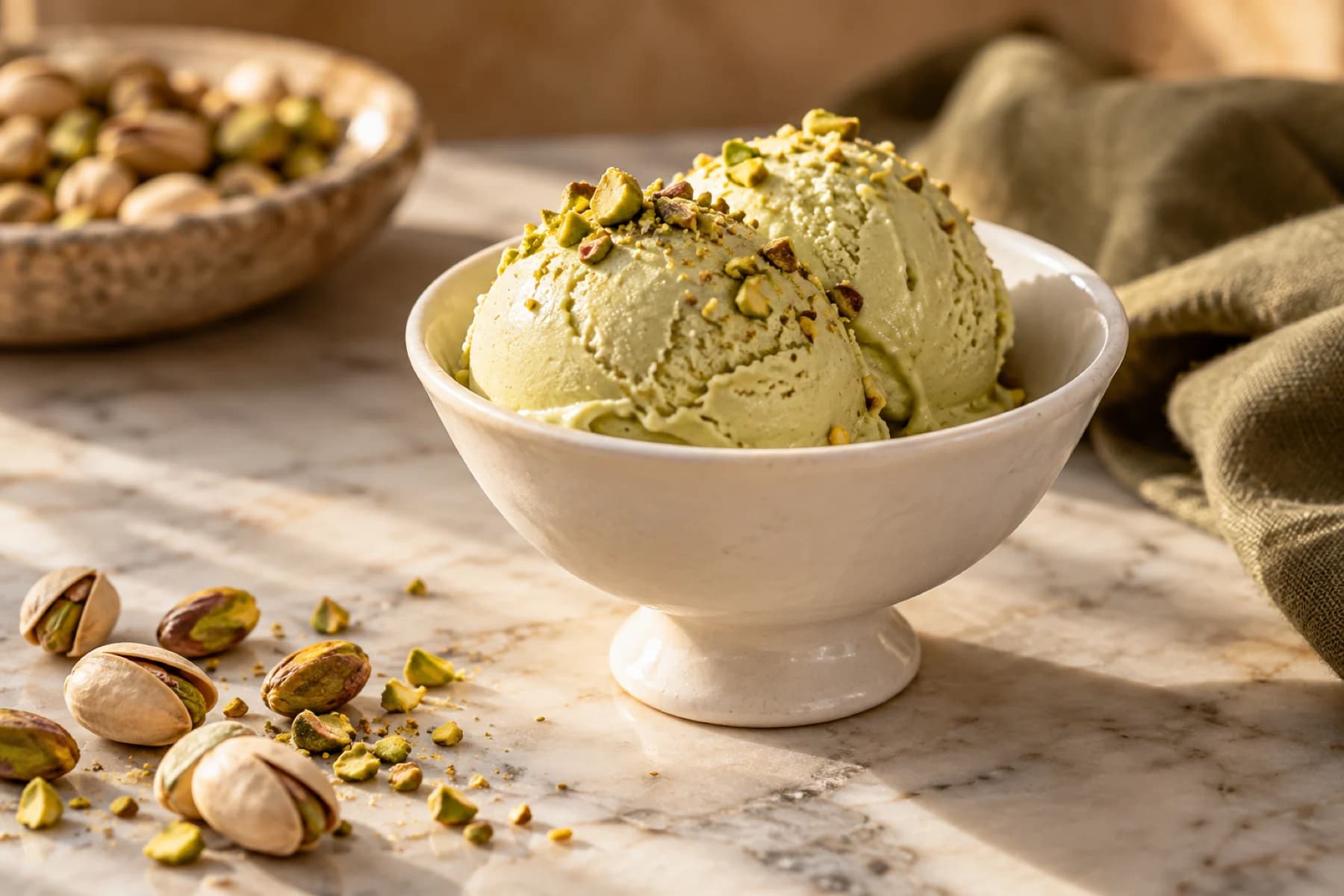
What is gelato?
Gelato is the Italian word for ice cream, and it literally means frozen. In English it names a specific artisanal style: a dense, smooth frozen dessert made from milk, sugar and flavorings, sold at a shop called a gelateria.
The word is pronounced jeh-LAH-toh. Menu names are often Italian: fior di latte is plain milk, crema is a custard flavor, stracciatella is milk gelato with chocolate chunks, and nocciola, pistacchio and limone mean hazelnut, pistachio and lemon. Sorbetto is the Italian word for sorbet, and affogato, which means drowned, is a scoop of gelato with espresso poured over it.
Its origin is disputed. Some accounts credit Cosimo Ruggeri and Bernardo Buontalenti in sixteenth-century Florence, and Buontalenti is linked to a frozen mixture made around 1565 with ice, salt, lemon, wine, milk, sugar, egg and honey. Other accounts say Sicilian cooks gradually adapted sherbet recipes. In 1686 a Sicilian, Francesco Procopio dei Coltelli, opened a Paris café and received a royal license from Louis XIV, and in 1945 an inventor in Bologna built the first automated gelato machine.
What does gelato taste like?
Milk gelato tastes sweet and dairy-forward, and the flavor name tells you where the rest comes from: cocoa and chocolate in chocolate, nut paste or nuts in hazelnut and pistachio, fruit or purée in fruit flavors. Fior di latte, the original plain base, has no added flavoring and no eggs, so milk and sugar are all you taste.
Gelato takes in less air than many ice creams, roughly 20 to 35 percent of its volume, so a spoonful feels dense for its size. It is served at about 7 to 12 degrees Fahrenheit (-14 to -11 degrees Celsius), and often with a flat spade rather than a round scoop. Artisanal gelato runs about 6 to 9 percent butterfat, so the creamy feel comes largely from that density and not from a high fat content.
Gelato is sweet; sugar can make up 14 to 24 percent of the mix and also keeps ice crystals small. A crema flavor made with egg yolks tastes richer and looks yellower than fior di latte. A fruit sorbetto is sharper and icier than a milk-based fruit gelato, and lemon sorbetto tastes especially tart after a sweet dairy flavor.
Gelato ingredients and how churning affects texture
Milk is the main ingredient, roughly 60 to 80 percent of the mix, with 5 to 20 percent cream and sugar added. A custard-style base adds egg yolks, chocolate flavors add cocoa or chocolate, and nut flavors add nut paste or nuts. A sorbetto uses water, sugar and fruit or fruit purée.
The base is heated to 85 degrees Celsius (185 degrees Fahrenheit) to pasteurize it, cooled to 5 degrees Celsius (41 degrees Fahrenheit), then frozen in batches while it is stirred. Stirring is what adds the air, and the amount of air together with the sugar decides whether the result is dense and smooth or icy.
A US packaged chocolate gelato lists milk, sugar, cream, egg, egg yolk, chocolate, cocoa and soy lecithin, and its maker describes it as containing less air than regular ice cream. The US federal standard for ice cream requires at least 10 percent milkfat, above the 6 to 9 percent of artisanal gelato, which is why the Italian word shows up on labels in its place.
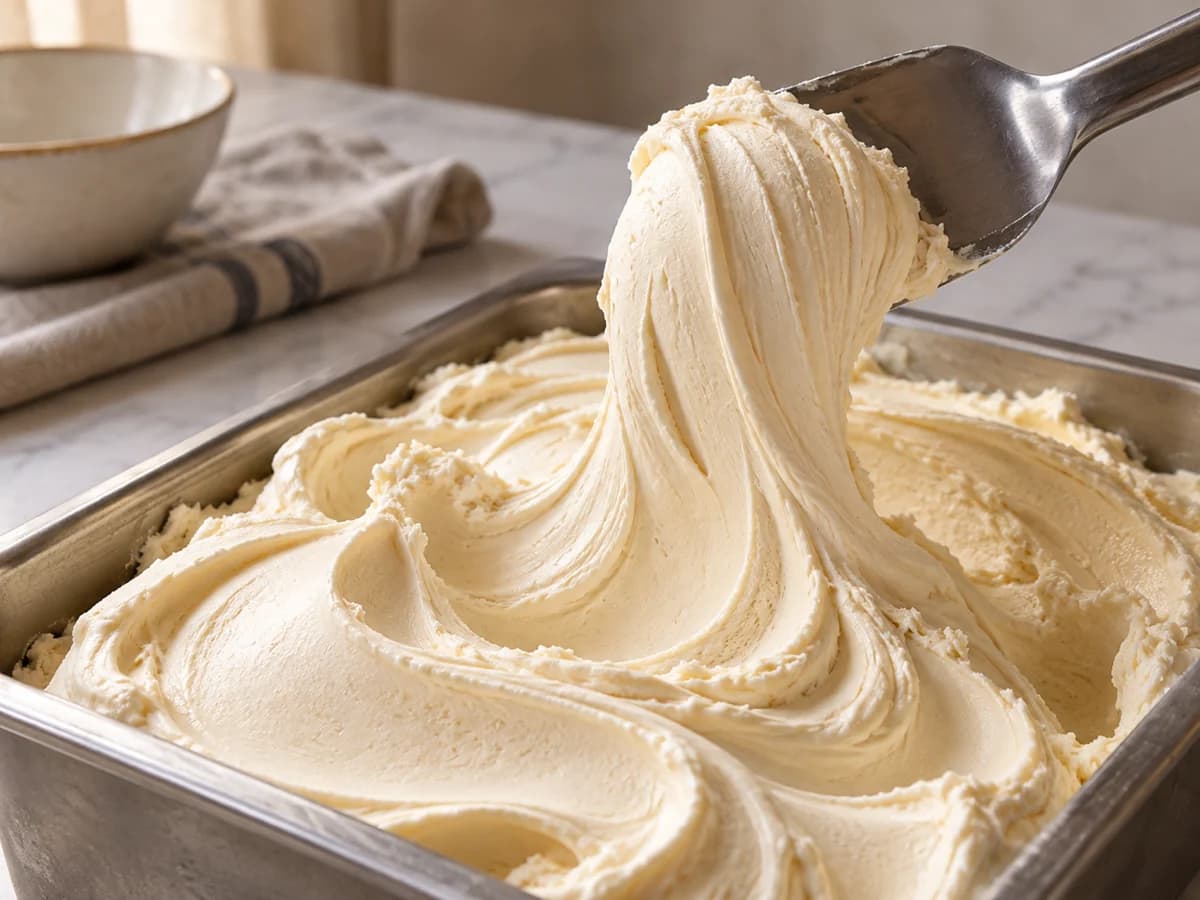
Milk gelato and fruit sorbetto
Traditional gelato flavors are fior di latte, crema, vanilla, chocolate, hazelnut, almond and pistachio; fruit flavors are the modern addition. Stracciatella is fior di latte with chocolate chunks. Egg varies by flavor even inside one shop: a US chain's chart marks egg on its coffee, chocolate, hazelnut, pistachio and orange blossom crema flavors, but not on vanilla or mint chocolate chip.
Sorbetto is made with water, sugar and fruit and, in a US packaged range, without dairy. Related Italian desserts include granita, a Sicilian mix stirred while it freezes into tiny ice crystals, and semifreddo, a class of semi-frozen desserts. Granita in Palermo and western Sicily is chunkier, while eastern versions are nearly as smooth as sorbet. Italian ice is made from syrup concentrate or fruit purée over crushed ice.
American gelato counters go well beyond the Italian list. The same chain's chart has 25 gelato flavors and 17 sorbets, with chai latte, blueberry cheesecake, dulce de leche, speculoos and tiramisu beside hazelnut and stracciatella. Some flavors come with a topping, such as pistachio or gianduja, a chocolate-hazelnut mix, and the topping adds its own ingredients to the flavor.
Eating gelato from a cup or cone
Gelato comes in a cup or a cone, with a small spoon for the cup. Conventional wafer cones commonly contain wheat, so the cone changes the ingredients as well as the way you eat it. Affogato is usually served in a tall glass with a narrow bottom so the gelato melts into the espresso, and it is eaten with a spoon or sipped through a straw.
Affogato is classically made with fior di latte or vanilla gelato and one shot of espresso, and some versions add a liqueur such as amaretto. In Messina, Sicily, a creamy granita is a traditional breakfast, eaten with a brioche, and mezza con panna is coffee granita topped with whipped cream.
Try fior di latte before chocolate or pistachio, because the plain milk flavor makes the stronger one easier to notice afterward. In Italy affogato counts as a dessert, but restaurants elsewhere often list it as a drink, so it can appear under either heading on a menu. A cup removes the cone, but the flavor and the shared spade can still matter for an allergy.
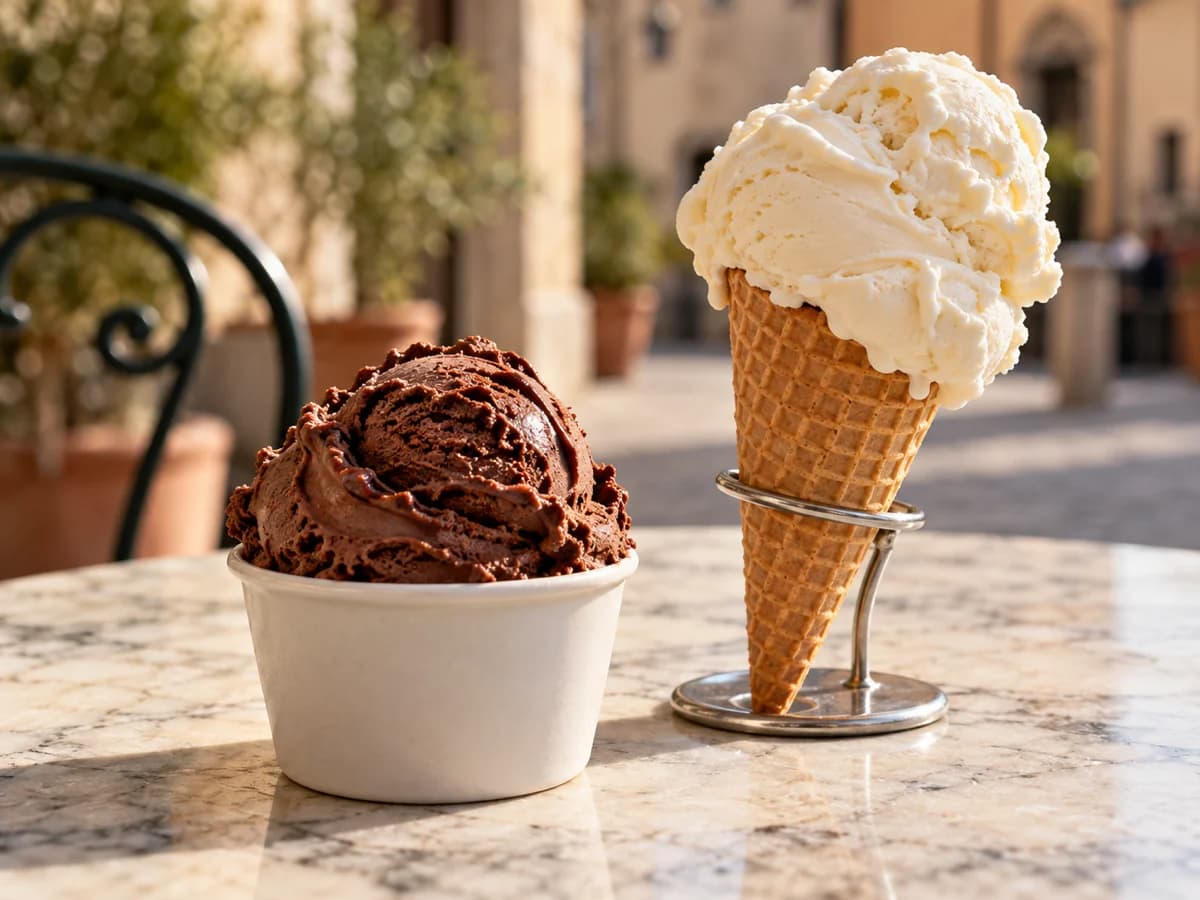
Ordering at an American gelato counter
Gelato, sorbetto, granita, semifreddo and affogato are different desserts, so the menu word matters. Fior di latte, crema and stracciatella are three different milk flavors: plain, custard and with chocolate chunks. Strawberry gelato and strawberry sorbetto are not the same item, because the gelato can contain milk and the sorbetto is usually water, sugar and fruit.
Size is set by each shop, and a shop that sells by weight or posts ounces describes the amount more exactly than small or medium does. Because gelato is served with a spade, the height above the rim says little about weight. If you want two flavors, ask whether they share one size or count as an extra portion.
Affogato is the usual order when you want dessert and coffee together. Pistachio or hazelnut topping on a plain flavor adds nuts, so say whether you want the topping. A cup instead of a cone, and a single plain flavor, make the portion easier to compare from shop to shop.
Dairy, eggs, nuts and gluten
Milk gelato is not vegan. A US chain's chart marks milk and soy on every milk-based gelato flavor, egg on some, and tree nuts on pistachio, hazelnut and nougat. Peanuts are unmarked there, yet a US packaged caramel gelato lists milk, egg yolk, whole egg and soy lecithin and warns it may contain peanuts, tree nuts and wheat. The chart also names celery, crustaceans, sesame, lupin, molluscs, mustard, fish and sulfites as other allergens, and warns of traces from suppliers, laboratories and in-store use.
A sorbet can still carry allergens: the chart marks tree nuts on its pistachio sorbet, coconut on its coconut mango lime sorbet, and milk and soy on a raspberry sorbet with white chocolate topping. Its other sorbets carry no marks, and it states that none of its products contain animal gelatin, although some contain potato protein. The gluten column is empty for every flavor, and two cookie and dessert flavors, speculoos and tiramisu, are labeled gluten free. A cone commonly contains wheat, and the chart does not describe cones.
The traditional base is pasteurized, and one US packaged maker states that its milk, cream and eggs and its finished products are pasteurized, but that does not describe every counter gelato. For an allergy, ask which flavor you are getting and whether the same spade serves other flavors. A cup avoids the cone, not contact with the display.
Which should you order?
For a milk-forward flavor, order fior di latte; for cocoa, order chocolate; for a nut flavor, order pistachio. Choose a cup to skip the cone. For dairy-free eating, use a sorbetto whose ingredient list has no milk.
A useful question for the restaurant
Is this flavor made with milk or egg, and can you use a clean scoop if I have an allergy?
Ordering suggestions reflect taste preferences, not a guarantee about the restaurant’s ingredients.
Common questions
How many calories are in gelato?
A U.S. packaged chocolate gelato has 290 calories per 2/3-cup (132 g) serving. A packaged sea-salt-caramel gelato has 320 calories per 2/3-cup (128 g) serving. A counter cup can be larger or smaller, and cones and toppings add more.
Is gelato gluten free?
Some gelato flavors are gluten-free, but gelato is not gluten-free as a category. One U.S. packaged flavor is labeled gluten-free while another warns it may contain wheat, so check the exact flavor and how it is served.
Is gelato vegan?
Milk-based gelato is not vegan. A fruit sorbetto can be dairy-free when it is made with water, sugar and fruit, juice or purée; check the flavor rather than relying on its fruit name.
Does gelato contain eggs?
Some gelato contains egg or egg yolk. A U.S. packaged chocolate gelato lists both, while other milk flavors at one U.S. gelato chain have no egg marker; check egg separately from milk.